
Day 3 – Tokyo
Our family visited TeamLab Planets in the Odaiba area of Tokyo on Friday, May 26, 2023. Technically this exhibit is on Toyosu, one of the series of manmade islands in Tokyo Bay which is also the home of another popular Tokyo tourist attraction, the relocated Toyosu Fish Market (formerly the Tsukiji Fish market).
We scheduled one of the later entry times which was around 7:30 pm for two reasons. First, hoping to provide some cushion in case our flight from Los Angeles was delayed and second, hoping that crowds might be a little more manageable later in the day. I think the strategy worked, but we may have just been lucky.

If you’re not familiar with TeamLab, it is a Japan-based company that creates immersive art environments which happen to be incredibly “Instagrammable”. TeamLab was founded in the early 2000s, so they can’t have started out with that goal in mind. Instead, imo, it seems they were inspired, at least in part, by Japanese artist Yayoi Kusama’s work, taking her ideas and expanding them using new technologies. With the end of the pandemic, the rise of social media and the Japanese people’s love of picture-taking, the combination is now the perfect storm. Their exhibits are extremely popular.
While TeamLab started in Japan, it has hosted temporary exhibitions in multiple countries including the US.
There were originally two permanent installations in Tokyo – both in the Odaiba/Toyosu area – TeamLab Borderless – a larger, more free flowing set of exhibits and TeamLab Planets – a smaller set of exhibits with a set path between them. Borderless is currently closed and Planets is technically only open until the end of 2023. If your trip is later, I wouldn’t be too concerned. Based on their popularity, I imagine at least one will be open in 2024 and beyond.
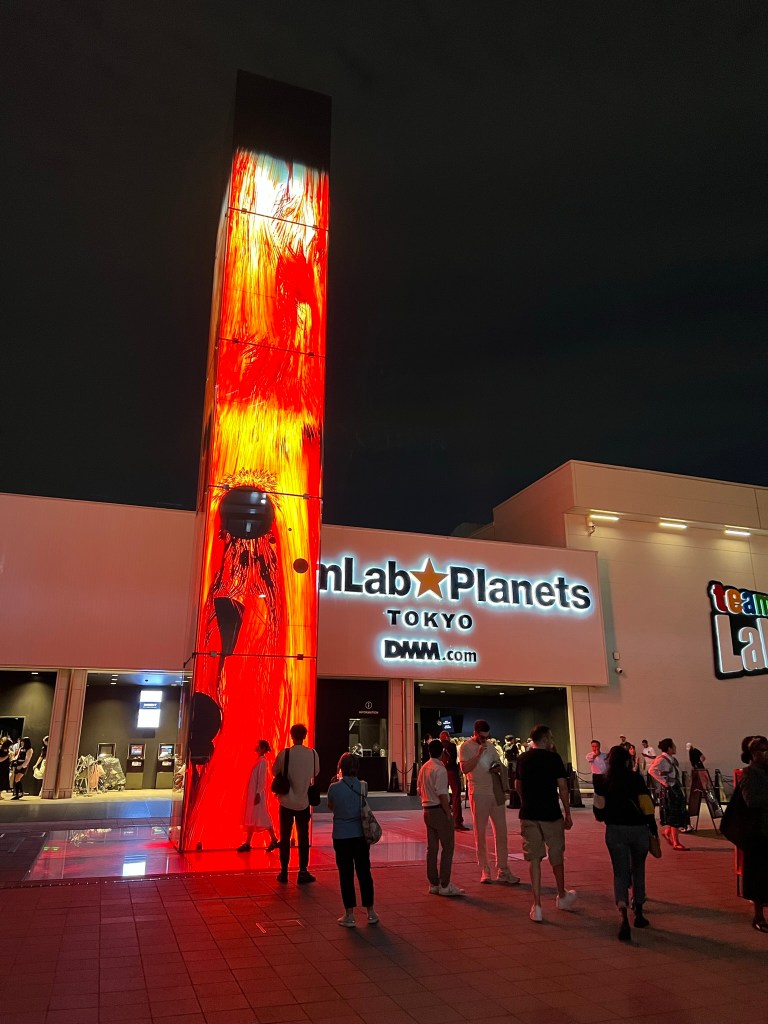
The experience starts before you enter the building with a digital monolith currently themed to fire (previously it featured a water theme). The graphics respond to people near it and there’s an app where you can download one of its “flames”.
Side Complaint: What is going on with the TeamLabs logo? It doesn’t read as “We design creative and transformative modern interactive art exhibits”. Instead all I get is “We design children’s video games. In 2003”.
Upon your entry in Planets, you will be asked to store all items including your shoes and socks, in a free locker. The only item they recommend you carry with you is, of course, your cell phone. They will also alert you to a couple of key points: 1. You will walk through water – at some points, the water will be knee-deep. (We did not find this to be the case. Our family is on the taller side but, even for me, the shortest member, the water only came a little more than halfway up my calf.) 2. The floor is mirrored in some places, so it is advisable to wear shorts under skirts or dresses. (TeamLab also provides shorts to guests that need them either for the mirrors or the water exhibits.)
I will add that because of the visually sensory nature of the exhibits, some sections could be overwhelming.
We were given the choice of which side to enter – Water or Garden – but were advised that Water closed earlier so it was a better choice based on our entry time. I was glad we chose Water first. It seemed like a more natural progression.
Before you enter each exhibit, there is a plaque with information about the meaning behind the concept. I am normally an avid reader of all museum plaques but didn’t finish even the first one here. There’s a pressure at times to keep moving in hopes of staying ahead of other clumps of people, and the concepts were just beyond my comprehension after a long couple of days of travel. Maybe they would resonate if you were alone in the space, but I couldn’t reach the headspace necessary in the environment as it is. I’m not knocking it. I enjoyed it even without knowing that once the “boundary between the body and the artwork dissolves, the boundaries between the self, others, and the world become something continuous”.
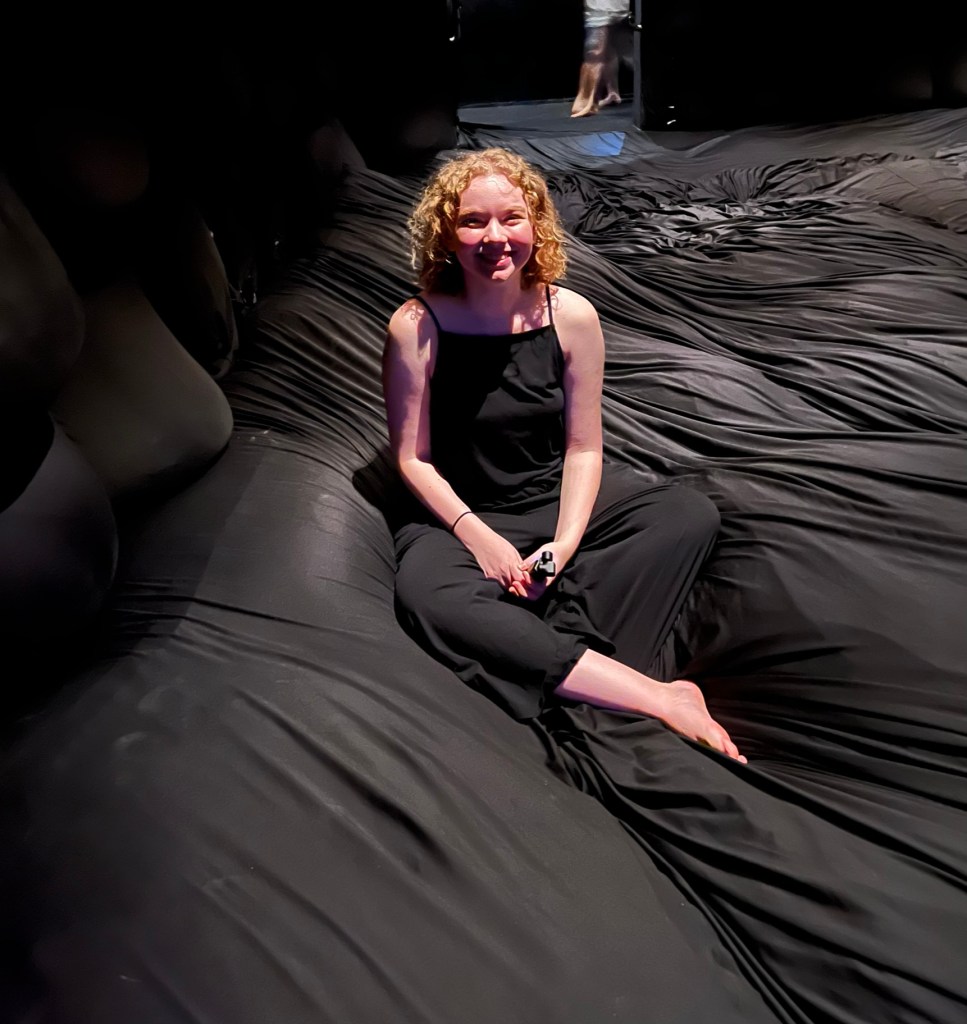
To enter the first exhibit, you walk uphill through flowing water in a dark, narrow hallway. After drying your feet, you enter the “Soft Black Hole”, a room of bouncy material covered in black fabric that you need to wade across to get to the next exhibit. It is not an easy task, but it was fun. If you have mobility issues or a lot of pride, you will want to skip this part.
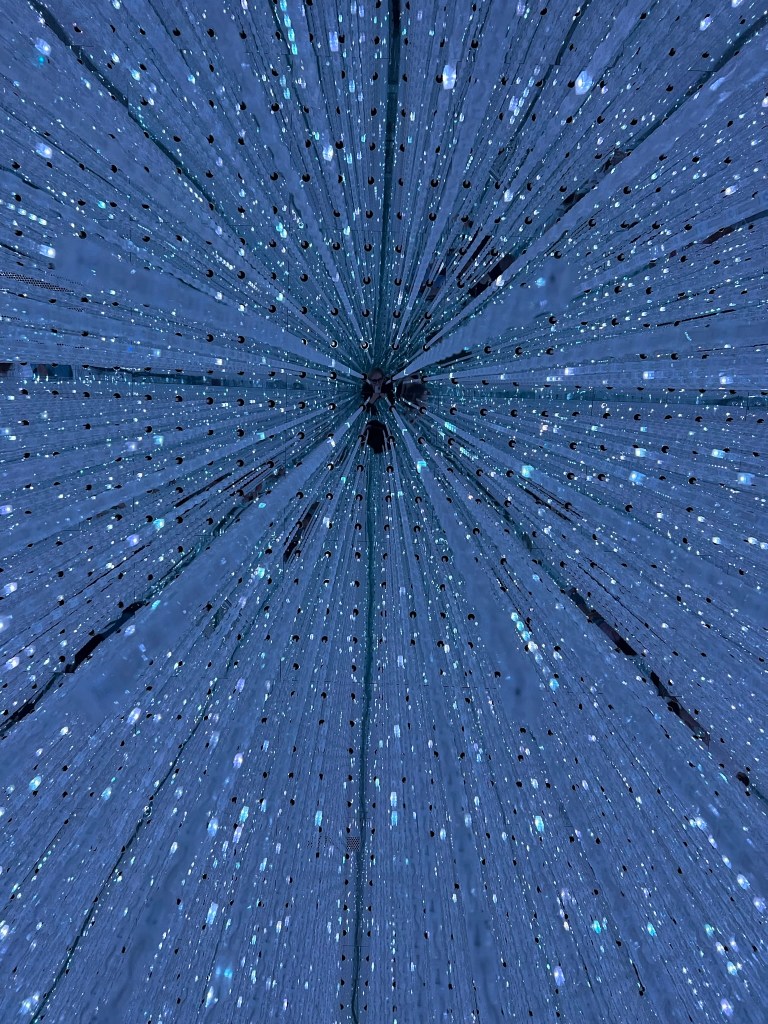
The next room, The Infinite Crystal Universe, was my favorite. A maze of LED light poles extend floor to ceiling in a room with mirrored walls, ceilings and floors. The LED lights change colors and patterns in time with a wide selection of classical music creating a serene atmosphere, even amidst the crowds. Eventually the maze opens up to a larger room where you can sit on the floor and enjoy the show.
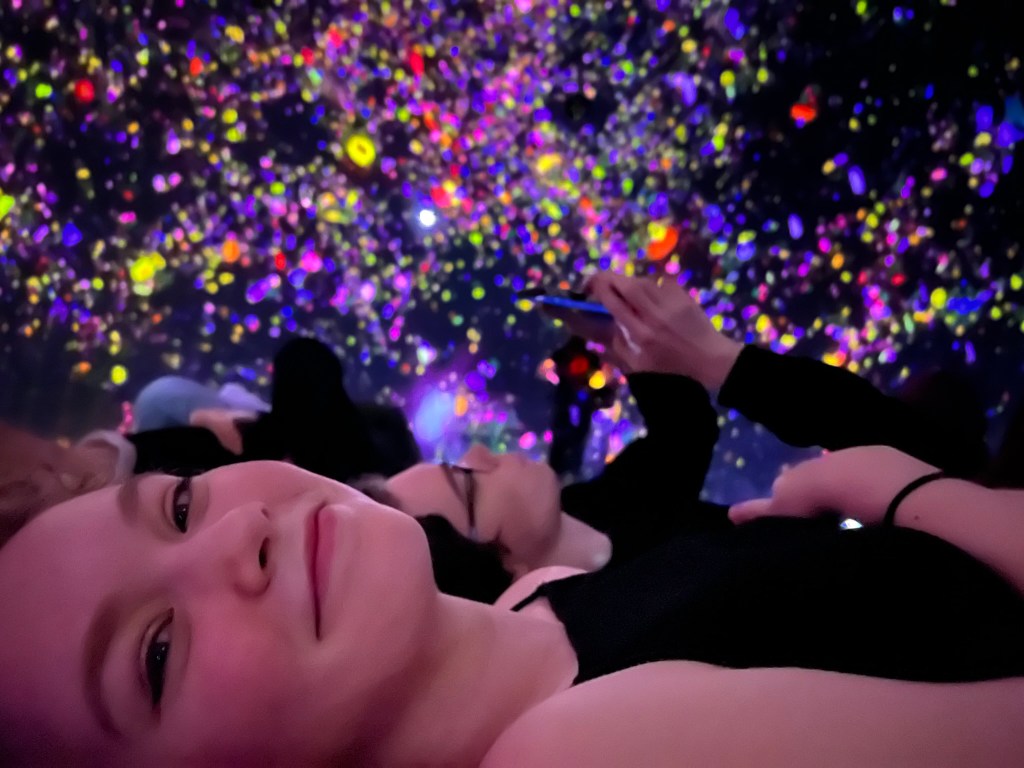
My sort of selfie with me waaaaaaaaaayyyyyyyy down there.
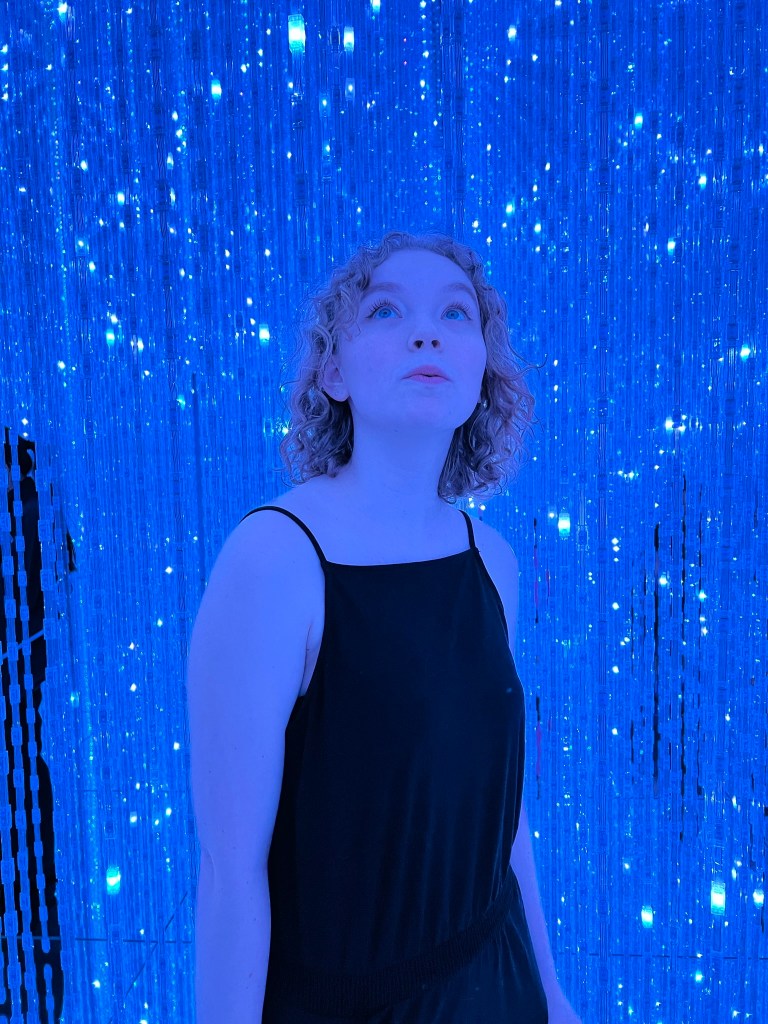
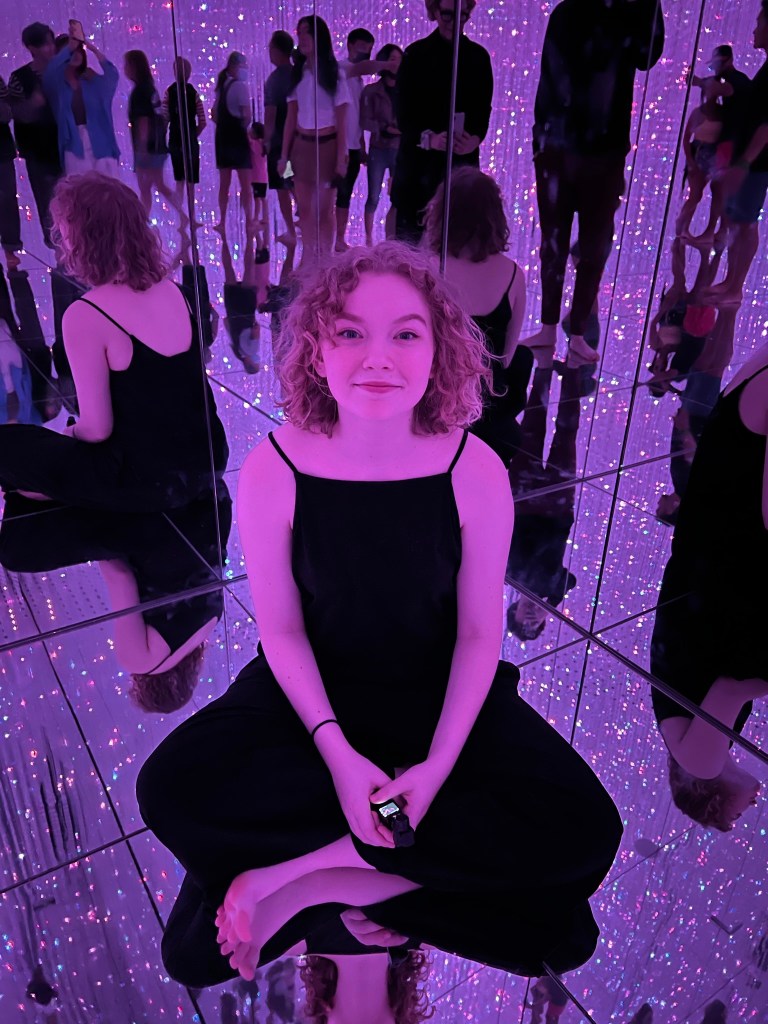

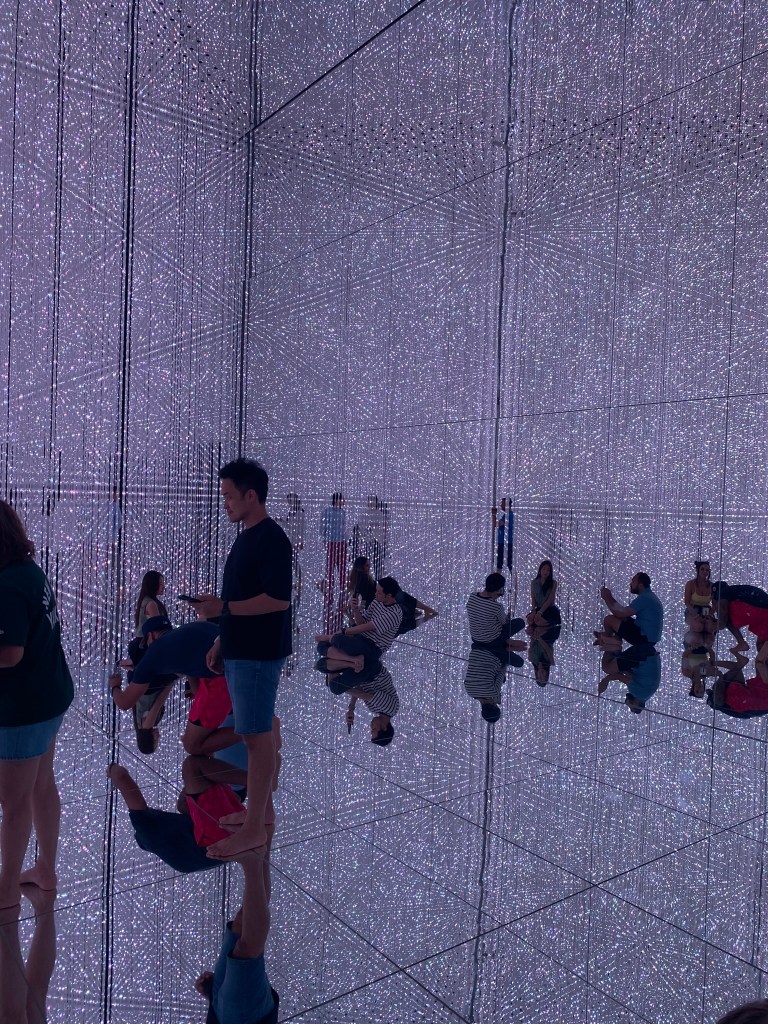
Rowan submitted zero photos of himself by the way. And didn’t let me take any.
After that, you’re back in the water with Drawing On The Water Surface. The surface of the milky water of the room is alive with colorful digital koi that react to your movement. The idea was fun but we were a little put off by the lukewarm, cloudy water so didn’t stay long in here.
Next is Expanding Three-Dimensional Existence, a room filled with large soft white spheres – some tethered to the ceiling and floors but others free to bounce around the space. This was fun for the kids and one of the rooms where, because of the spheres, it was easier to take pictures blocking out others.
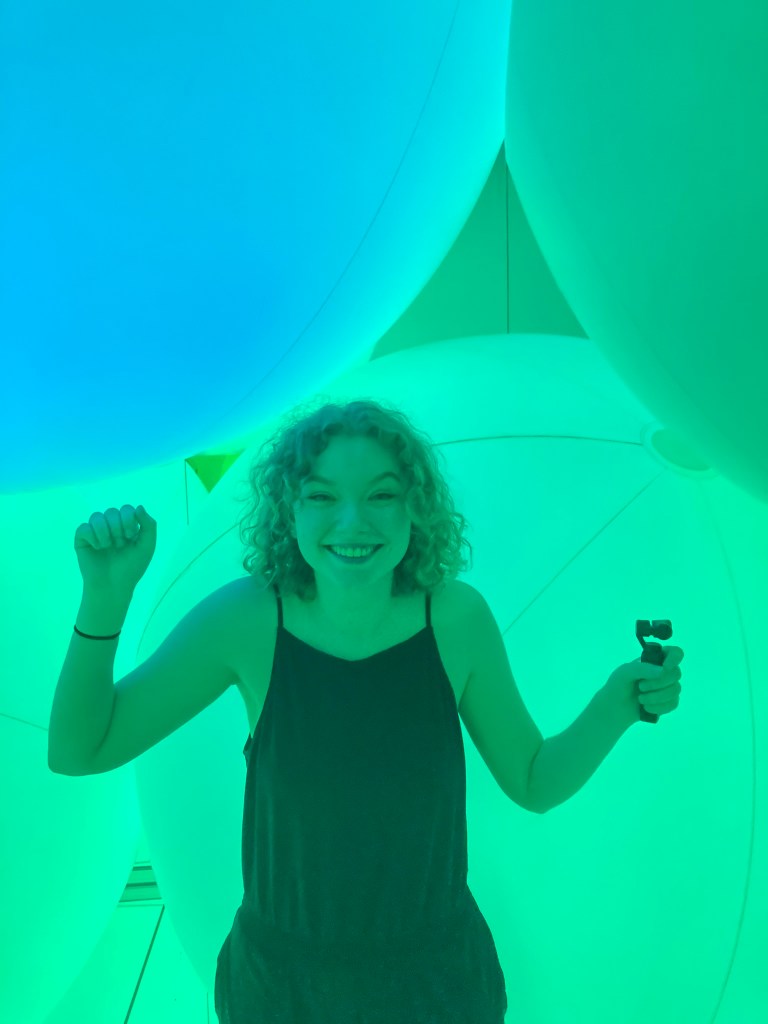
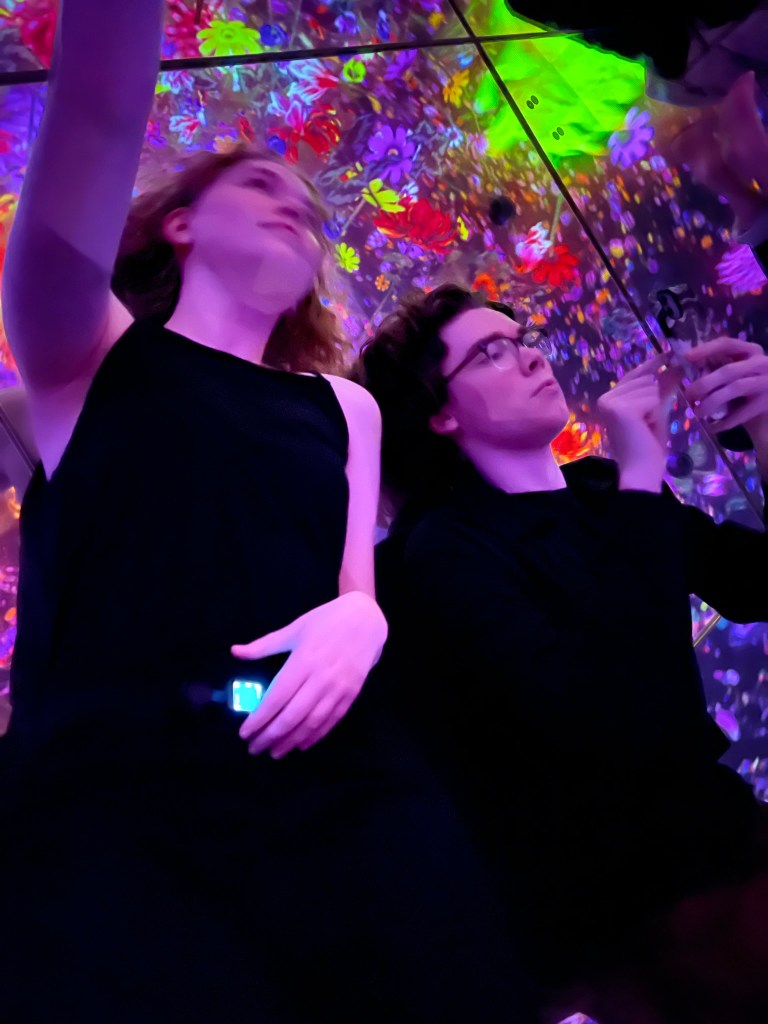
In Floating In The Falling Universe of Flowers, you lie on the floor and stare up into projections of large flowers swirling around the room. I felt this room, although simple, was very impactful. However, it was also disorienting for me. I was only able to stay for a couple of minutes before leaving because I was dizzy. The kids were totally fine.
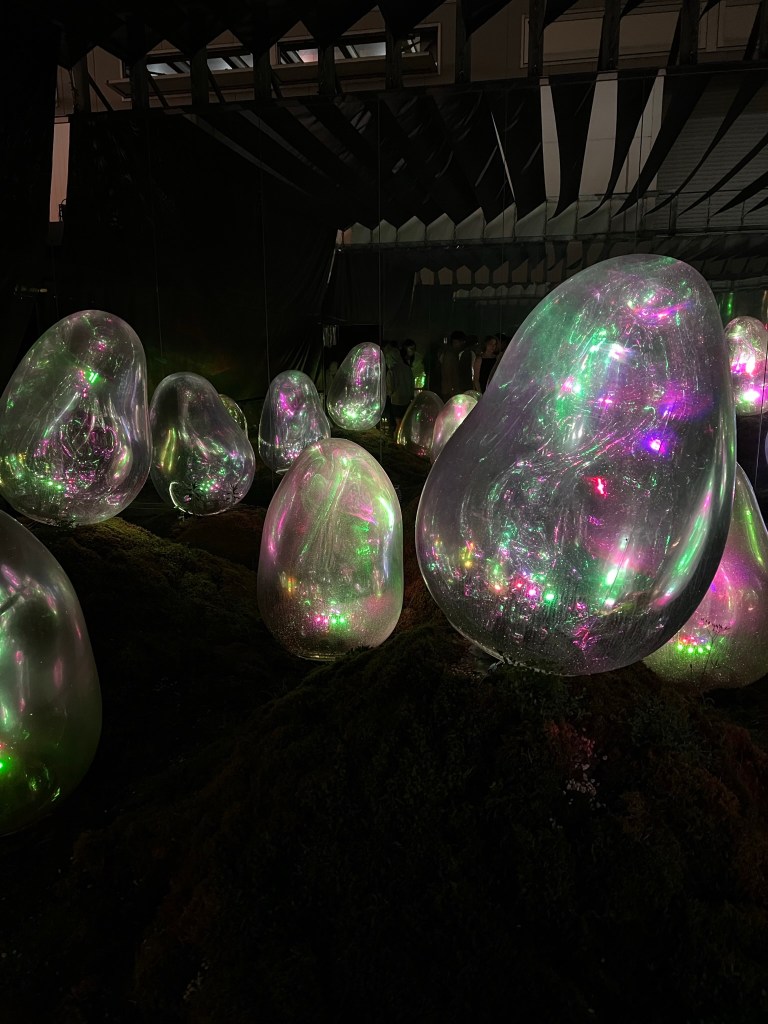
After this, I think we transferred to the Garden portion. The first section of Garden is a collection of glowing egg-like “rocks” that can be pushed so they weeble and wobble. I didn’t see many people actually pushing them though. It took us a few minutes to realize that in this part, we were technically outside. While pretty, there isn’t much reason to stay in this section long.
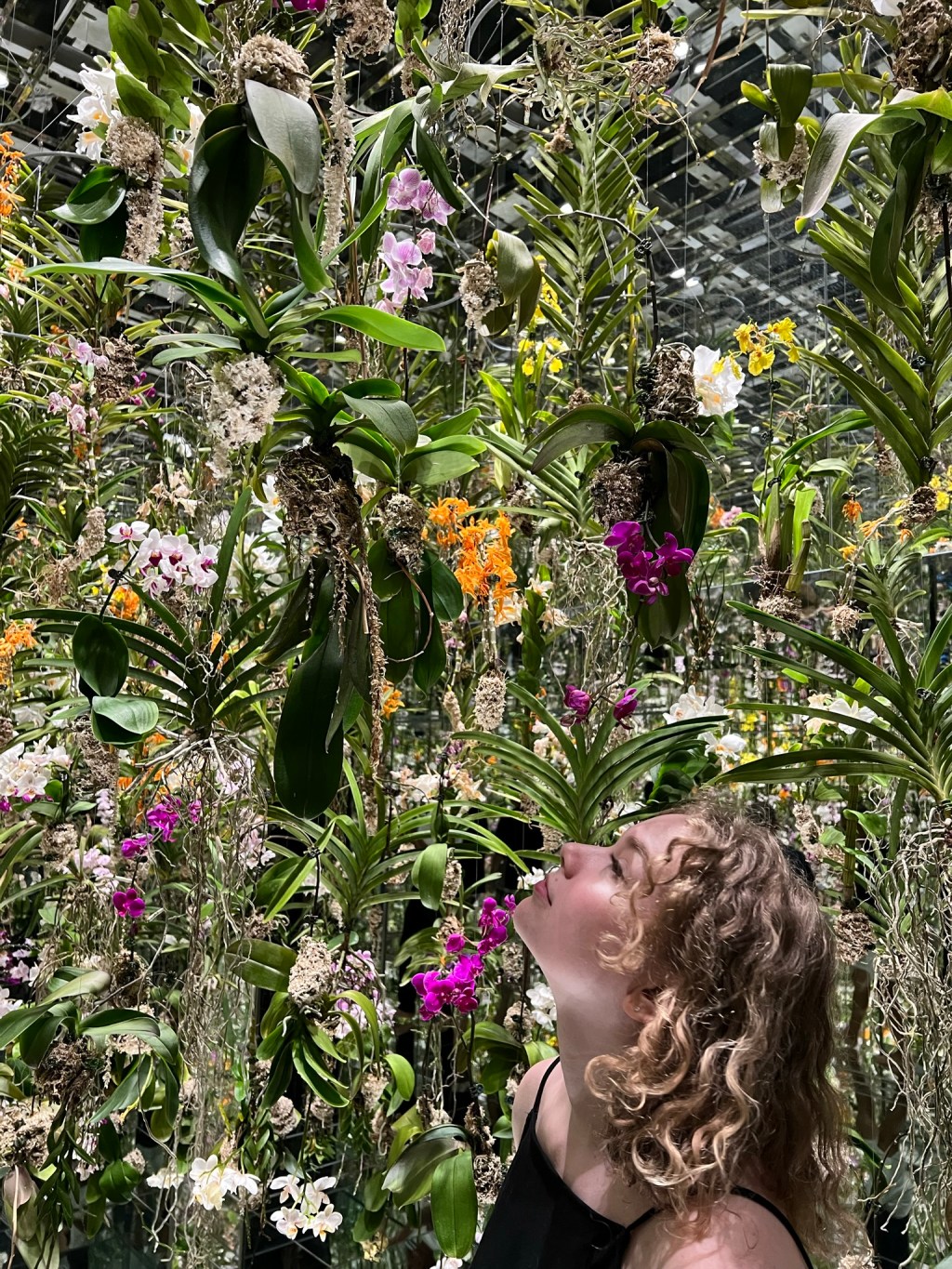
After the rocks, we queued for a few moments looking into a strange room filled with hanging flowers. The flowers moved up and down sometimes reaching almost all the way to the ground. Hanging at different lengths, they created pockets within a flower forest.
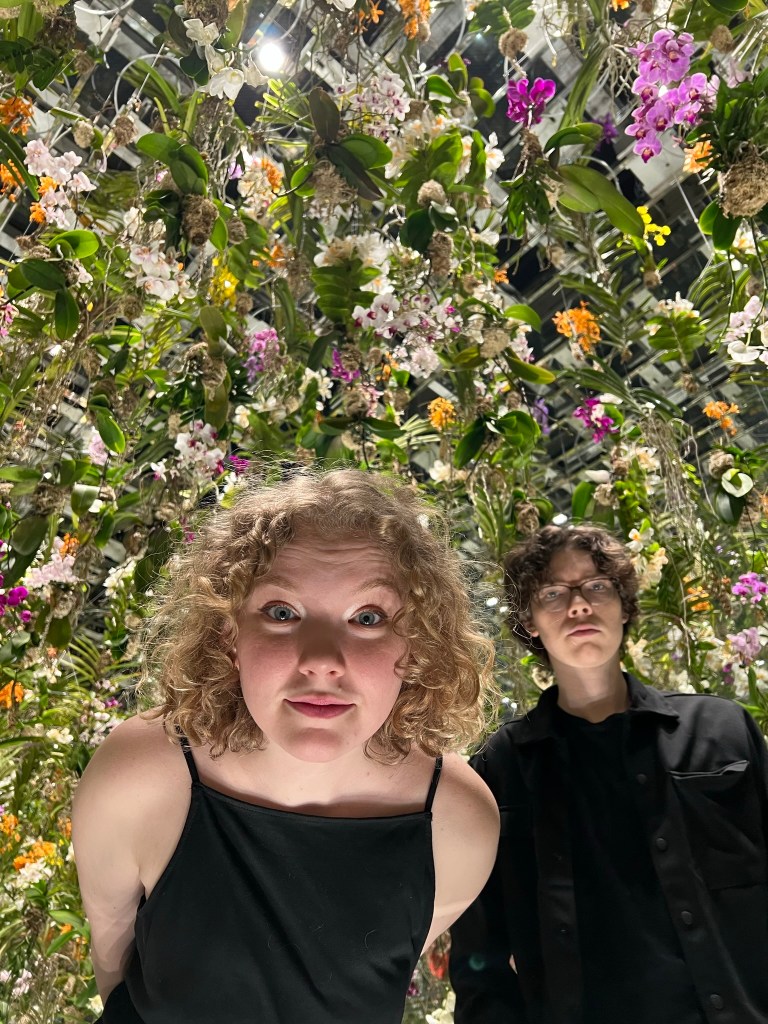
This was the only room during our visit that was timed, once the group ahead of us cleared out, we were encouraged to enter the area even if we had to crawl under the flowers (no flower touching was allowed). I was surprised when I realized that all of the orchids were live.
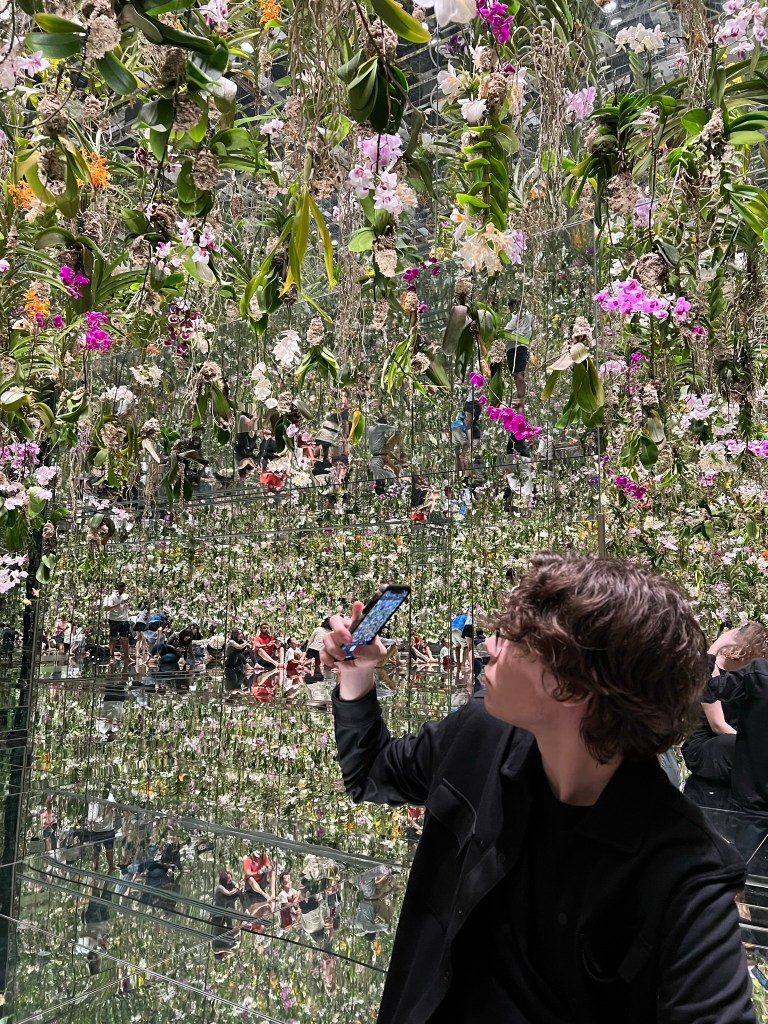
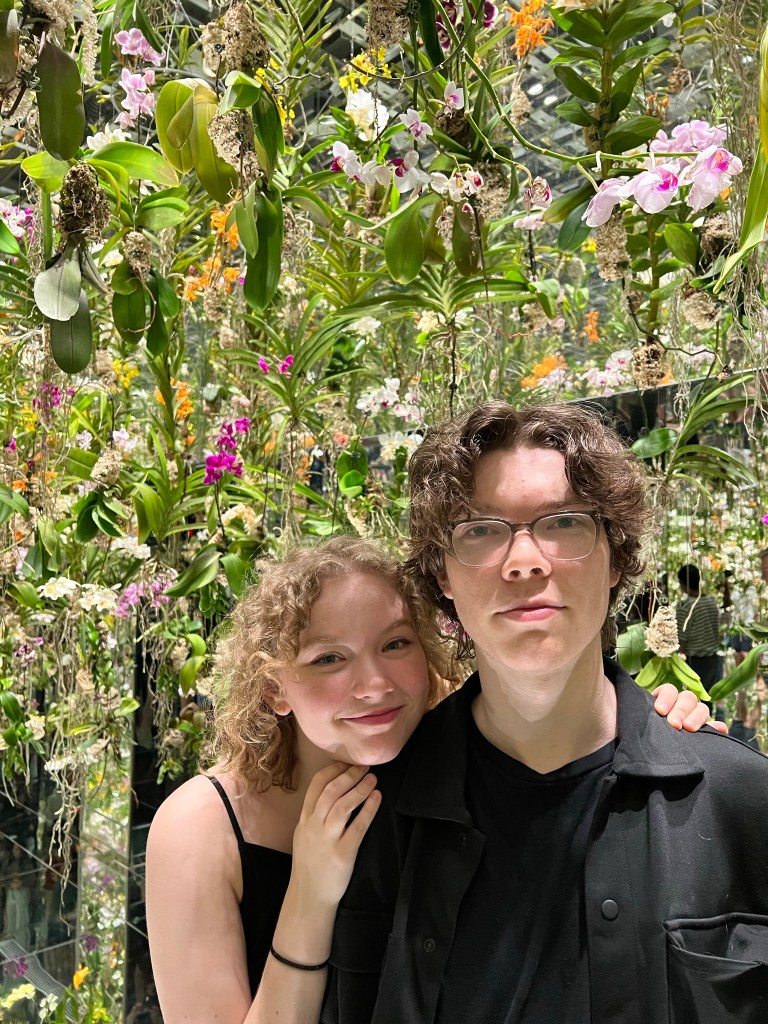
In this room too, you could take photos without capturing others in the background which was nice. It also created a sense of isolation even though there were easily 100 other people in the space with us.
Social media experts can take the photos and edit out other people so it looks like they were alone. I am too lazy/busy to do that so the photos from our visit show what you can get if you aren’t a great photographer and aren’t likely to edit the photos later. We also didn’t spend time waiting for open spots. That being said, my photos and videos don’t accurately convey how it feels when you’re actually there. It feels better than it looks.
In all I think we spent a little over an hour at TeamLab Planets and that seemed like plenty. In hindsight, I would have stayed longer in the Infinite Universe area. I also would have liked to spend more time exploring the Toyosu and Odaiba islands but most things were closed by the time we left the attraction. We were also ridiculously tired.
The permanent TeamLab galleries in Tokyo are accessible through either walk-up entry or reservation. Walk-up means making a timed reservation on-site at a kiosk so it’s not exactly just “walking right in”. These walk-ups are often sold out and even reservations in advance can be difficult to obtain. We were able to reserve ours through the Klook app about a week ahead of time. But I think we were lucky and a bit ahead of the tourism surge expected in Japan this summer. If it is one of your top attractions, I would make a reservation as soon as possible. It appears that new reservation slots are released two-three months in advance. For instance, the website currently says reservations for September will be released in late June.
If you are able to get a “walk-up” reservation but have to kill some time before your entry, there is plenty to do in the area while waiting. There are also a few food options immediately by the building.
Ticket prices range from $7-$25 depending on your age and when you visit. You can also reserve through third parties like the Klook app which may offer a discount. Even if it doesn’t, the convenience of their app compared to many Japan attractions’ individual websites or apps can make it worthwhile to book through them instead. (And all of your tickets are stored in one location on your phone.)
Because we were staying at The Conrad, it was incredibly easy and inexpensive to get to the exhibit. We boarded the Yurikamome elevated train at the Shiodome Station just outside the doors to The Conrad. After a short and scenic ride, we exited just a two minute walk from the entry to the building.
While TeamLab Planets is touristy and crowded and possibly a loose interpretation of “art”, we all enjoyed it. But our family likes things like this. Some online reviewers did not like the crowds and others complained about the idea (and smell) of lots of people wading through water barefoot. I didn’t notice any strong odor even at the end of a summer day, but I’ll admit that this experience may not be for everyone.
TeamLab Planets is built for the Instagram crowd and is definitely more fun if you enjoy taking lots of pictures of yourself, which I don’t personally, but I’d still do it again and look forward to visiting other TeamLab exhibitions in the future.


 Scaredy Cat Travels
Leave a reply to Ruby Styler Cancel reply